Introduction
Why does one website appear at the top of Google Search while another struggles to attract organic traffic? Search intent, content quality, mobile usability, and local relevance are some of the elements that go into the response.Lorem ipsum dolor sit amet, consectetur adipiscing elit. Ut elit tellus, luctus nec ullamcorper mattis, pulvinar dapibus leo.
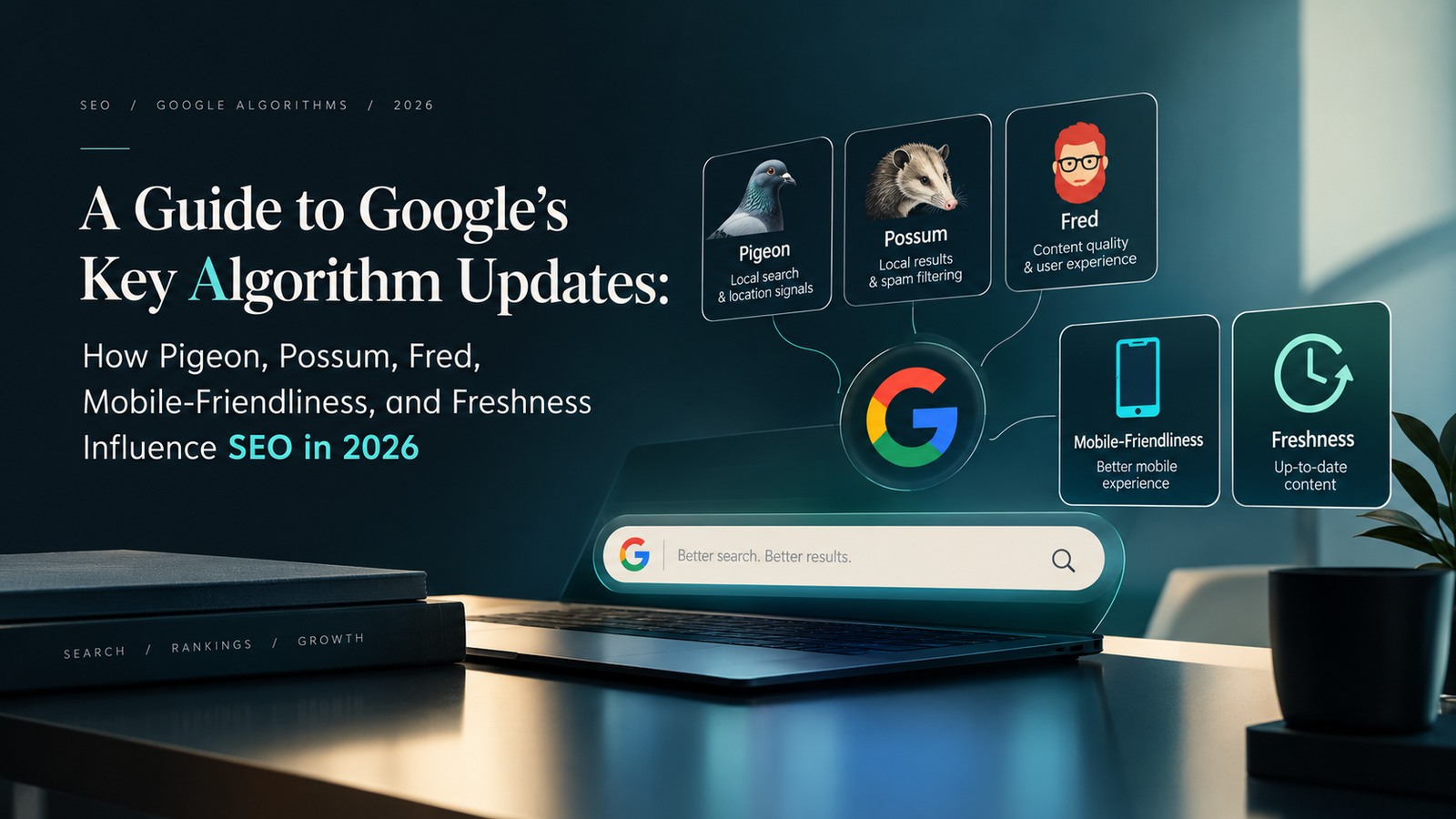
Google algorithm updates have continuously shaped search engine optimisation (SEO), influencing how websites appear in search results. Although Pigeon, Possum, Fred, the Mobile-Friendly Update and Freshness Update were introduced years ago, understanding their impact helps digital marketers build stronger SEO strategies today.
In 2026, SEO success goes beyond achieving higher search rankings. It is on delivering useful, relevant and trustworthy experiences that meet users’ needs.
Table of Contents
1. Google Pigeon Update
2. Google Possum Update
3. Google Fred Update
4. Mobile-Friendly Update
5. Google Freshness Algorithm
6. How to Apply These Updates to Modern SEO
1. Google Pigeon Update: Improving Local SEO
Introduced in 2014, the Google Pigeon update improved the connection between Google’s local search results and traditional web search ranking signals.
It influenced how businesses appeared in local search results, making local relevance and website authority important considerations.
Impact on SEO:
– Enhanced the connection between Google Maps and Google Search results.
– Increased the importance of local relevance and traditional SEO signals.
– Highlighted the value of location-specific website content.
Modern SEO takeaway: Optimise your Google Business Profile, maintain consistent business information, collect genuine customer reviews and create useful local landing pages. These practices support local SEO, although rankings depend on multiple factors.
2. Google Possum Update: Improving Local Search Outcomes
Launched in 2016, a major shift in local search rankings was dubbed Google Possum by the community. It appeared to filter similar business listings and make search results more sensitive to the searcher’s location.
For example, two businesses offering similar services in the same area might not always appear together for every local query.
Impact on SEO:
– Made proximity more noticeable in local search visibility.
– Filtered some similar or closely located business listings.
– Highlighted the importance of business relevance and differentiation.
Modern SEO takeaway: Keep your business profile accurate, clearly communicate your services and build a genuine local presence. Avoid creating duplicate business listings to manipulate rankings.
3. Google Fred Update: Content Quality Over Advertising
The Google Fred update, associated with ranking fluctuations in March 2017, is an unofficial name used by the SEO community. Google did not formally confirm it as a named algorithm update.
SEO professionals associated Fred with websites that prioritised advertising and monetisation over user experience, particularly pages containing low-value content.
Impact on SEO:
– Raised concerns about excessive advertising.
– Highlighted the risks of thin or unhelpful content.
-The significance of user-focused website experiences was reaffirmed.
Modern SEO takeaway: Publish original, informative content that answers real questions. Use advertisements responsibly, maintain readable layouts and ensure monetisation does not interfere with the user’s experience.
4. Mobile-Friendly Update: Optimising for Mobile Search
Introduced in April 2015, Google’s Mobile-Friendly Update, often called Mobilegeddon, increased the importance of mobile usability as a ranking signal for mobile searches.
Google subsequently moved to mobile-first indexing, meaning it primarily uses a website’s mobile version for indexing.
Impact on SEO:
– Encouraged mobile-responsive website design.
– Emphasised readable text and accessible navigation.
– Made mobile usability an essential part of technical SEO.
Modern SEO takeaway: Use responsive design, optimise page speed, make buttons easy to tap and ensure important content is available on mobile devices. Test your pages across screen sizes and monitor technical issues using Google Search Console.
5. Google Freshness Algorithm: Keeping Content Relevant
Google’s Freshness Update, announced in 2011, improved its ability to show fresher results for searches where recent information matters, such as current events, product updates and trending topics.
However, freshness does not automatically make a page more valuable. Some searches benefit from comprehensive, evergreen content rather than frequent updates.
Impact on SEO:
– Improved results for queries that require recent information.
– Increased the importance of timely content in relevant searches.
– Encouraged publishers to maintain accurate, up-to-date information.
Modern SEO takeaway: Update articles when facts, statistics, tools or industry practices change. Add meaningful improvements instead of changing publication dates merely to appear current.
How to Apply These Lessons to Modern SEO
These historical Google algorithm updates reveal five practical priorities for digital marketers:
– Local SEO: Improve business information and local relevance.
– Content quality: Prioritise original, helpful and trustworthy information.
– Technical SEO: Ensure websites are mobile-friendly and accessible.
– Content freshness: Update information when it genuinely needs updating.
– User experience: Make every page useful, easy to navigate and aligned with search intent.
Google’s ranking systems continue to evolve, so no single optimisation guarantees first-page rankings. Monitor performance through Google Search Console, analyse organic traffic and focus on sustainable improvements rather than chasing individual updates.
Conclusion
Pigeon, Possum, Fred, the Mobile-Friendly Update and Freshness each highlight a different aspect of search engine optimisation: local relevance, business visibility, content quality, mobile usability and timely information.
Their lasting lesson is simple: effective SEO is not about manipulating algorithms; it is about helping people find the right information at the right time.
For digital marketers in 2026, combining technical SEO, useful content, local optimisation and continuous performance analysis provides a stronger foundation for long-term organic growth.
Want to See SEO Strategy in Action?
From understanding Google’s algorithm updates to creating search-friendly content, effective SEO starts with the right strategy.
Visit my digital marketing portfolio to explore my SEO insights, content strategies and creative projects. Discover how I approach digital marketing challenges and turn ideas into practical strategies that help brands improve their online presence.
Explore my portfolio: https://rithikakg.com/